Blog

FREE & Discounted Shipping Details
WINERY OPEN DAILY 10am-6pm
Tastings plus bottle, food, & merchandise sales in the winery. 
CURBSIDE PICK-UP
is available - just call us at 716-326-2191.
ORDER WINE ANYTIME
(minimum purchase - six 750ml bottles)
Promotion Code: GOODNEIGHBOR
FREE SHIPPING, EAST OF THE MISSISSIPPI
(minimum purchase of twelve 750ml bottles)
Promotion Code: EOMFREE
50% OFF SHIPPING, WEST OF THE MISSISSIPPI
(minimum purchase of twelve 750ml bottles)
Promotion Code: 50SHIPWEST
ORDER ONLINE OR CALL:
Visit our website anytime or give us a call (1-800-Drink-NY or 1-800-374-6569),10AM - 5:30PM, daily. Our tasting room team will be happy to speak with you. Please do share this offer with your friends and family!
AND NOW, THE FINE PRINT:
- Bottles must be 750ml or 375 ml for free/discounted shipping programs.
- You may order more than the six or twelve-bottle minimum quantity - please do order in increments of 3 bottles to reduce wasting packing materials.
- Requires signature of someone over 21 years old.
- We can ship to your home or work address.
- Transit times vary from two days to seven days. For West Coast & Florida, we generally ship wines on Monday to attempt to avoid weekend delays.
 May 4, 2020 at 6:18 AM
 Permalink
May Day and the Rites of Spring -
Your First Bottle Trial - Now until May 10th, just $7.50
"A little madness in the spring be wholesome even for the king”
Emily Dickinson
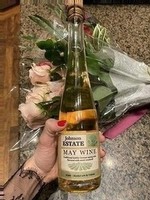 Maybe Emily Dickinson said this because the sweet woodruff used in Germany's May Day white wine punch was considered a tonic - or even aphrodisiac - and that this day is meant to celebrate spring, the season of fertility!
A German friend recently had this to say after she first tasted Johnson Estate's May Wine:
Hello Jennifer. Yesterday would have been my mother's 100th birthday. We celebrated it with one of her favorite desserts, homemade Strawberry Shortcake and your outstanding May Wine. I can assure you she would have loved it too. It is excellent!!!! What an art to capture the taste and consistency [of a German May Wine punch] in a bottle! That is truly a very special celebration drink. Congratulations!
Then my friend, Siggi T., shared her recipe for that Strawberry Shortcake (in our recipe section soon) and explained that the German tradition is to put fresh strawberries and small bouqets of sweet woodruff in the "Mai Bowle" punchbowl.
 Here's a woodland stream in Germany - it looks not unlike what we might find here in Western NY - and in fact, our "terroir" is very similar to that found in Germany. Hence, at Johnson Estate, we can grow the same grapes varieties grown in Germany: Riesling, Chardonnay, and Pinot Noir (Spatzburgunder in Germany). And we can make award-winning wines from those grapes. Testimony to this is our award-winning Semi-Dry Riesling, not to mention the awards won by other Rieslings, our Pinot Noir, and our May Wine.
Apr 27, 2020 at 4:20 PM
Permalink
Concord Grapes, Our Region's Specialty
Here's an article about our region's specialty - Concord Grapes - and their perhaps unappreciated nutritional value. Aside from our American tradition of peanut butter and jelly sandwiches, the fruit is a little forgotten. Rarely in New York State, and certainly not enough in Western NY, home of the largest Concord grape belt in the whole world, can one find a Concord pie. There's juice sometimes, but nothing else. A pity. Johnson Estate sells Grower's Grape Cooperative's 100% Concord Concentrate from Western NY (and the climate here helps us to produce a tarter version of this specialty compared to Welch's blended Concord juice) as well as Concord Filling (great in these Concord Grape Tarts/Bars). Naturally, Johnson Estate makes our own award-winning Concord Wine from Estate-grown grapes. We believe is the best in the world.
CONCORD GRAPES - 8 SURPRISING FACTS
Judith Upton, US News & Health Report
Talk about purple power – the pigment that gives Concord grapes their distinctive hue is responsible for the (super) fruit's super powers. Here are some, er, grape reasons to add more purple produce, including Concord grapes, to your shopping cart:
They may improve your health. Purple may be the color of royalty, but purple-hued foods signify improved health. One study found that Americans who eat purple and/or blue fruits and veggies (Concord grapes, blueberries, plums, eggplant) had smaller waistlines, lower blood pressure and reduced markers of inflammation compared to those who didn't eat purple/blue foods.
They provide benefits similar to red wine. Many of the beneficial polyphenols found in Concord grapes are the same as those present in red wine. Hundreds of studies conducted over decades show that these natural compounds promote cardiovascular health.
They're nutrient-rich. About 19 Concord grapes (one handful) contain around 30 calories and equal 1/2 cup or one serving of fruit. And, if you're sipping 100 percent grape juice, you're scoring the same beneficial polyphenols of the fruit because the beverage is made from the skin, seeds and flesh of Concord grapes. Cheers to that!
They contain compounds that fight free radicals. While human clinical trials are limited, mounting laboratory, animal-model and other types of research studies suggest that purple foods, such as Concord grapes, blueberries and plums, can neutralize free radicals that can cause DNA damage when left unchecked.
They relax your arteries. Relaxed arteries are considered healthy arteries. Two decades' worth of research shows that Concord grapes and 100 percent grape juice are good for the heart and help maintain clean and flexible arteries that improve blood flow. This is thanks to the potent polyphenols in the super fruit.
They help keep your mind sharp. Concord grapes, grape juice and red wine may also help maintain grey matter as you age. That means an improvement in cognitive function and a reduced risk for declines in memory, due to the beneficial cardiovascular and anti-inflammatory properties, according to laboratory, animal model and small human clinical trials.
They're natural performance-enhancers. Studies on antioxidant supplements suggest a reduction in markers for inflammation among athletes. One small human clinical trail that included 12 adult runners reported that those who supplemented their diet with purple grape juice had improved endurance.
They may help boost immunity. One study of 85 middle-aged adults found that those who were given 100 percent grape juice daily for nine weeks (in the absence of eating any other blue/purple foods) had an increase in a certain type of immune system cell compared to those who drank a placebo beverage.
Mar 20, 2020 at 5:35 AM
Permalink
March - Maple Madness
March - Maple Madness - Celebrate at Johnson Estate with Maple Liqueur & French Crêpes!
In Western New York and Pennsylvania, the maple tapping season usually begins in March and we begin to see tubing and pails attached to large sugar maple trees. Soon the maple syrup will be simmering away and the local sugar shacks and pancake houses will be open for business.
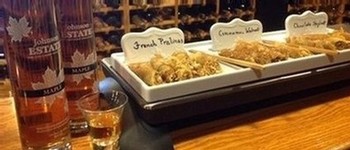
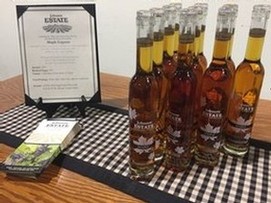
Johnson Estate's Maple Liqueur
Winemaker, Jeff Murphy, loves maple syrup and made an aperitif using estate-grown grape spirits, Vidal wine, and local syrup. The Maple Liqueur tastes like a combination of ice wine and sherry, with a hint of maple on fhs finish. Johnson Estate released this new liqueur in March 2015, just as the region’s tapping season began. To celebrate NYS Maple Weekends, Fred suggested that the winery serve Maple Liqueur and crêpes, which Fanny Tauzin-Dauga, a 2014 French winery intern, made for us during her stay here. So each year, Johnson Estate, a member of the NYS Maple Association participates in Maple Weekends.
A Tasting Room Tradition - Celebrating with French Crêpes
It has become Johnson Estate's annual tradition to serve Julia Child’s French Crêpes and Fancy Ground Nuts with a glass of the Maple Liqueur on the NYS Maple Association’s designated weekends. This year, Chef Edward Work from the Athenaeum Hotel will be flipping crêpes both weekends ($5/person). We’ll also be selling French Crêpe kits (white flour as well as gluten-free, buckwheat) so that you can make these treats at home. We also sell locally-made maple syrup and other maple products.
Mar 2, 2020 at 9:11 AM
Permalink
January 17-20 - All About Ice Wine

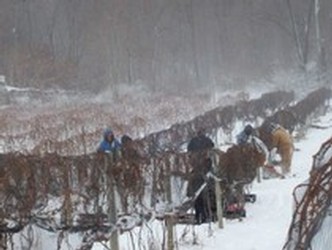
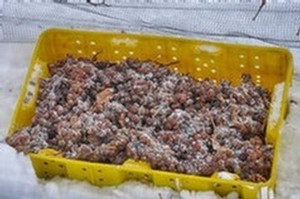
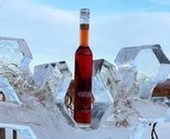
All About Ice Wine at Johnson Estate!
What it is, how it is made, and why it is packaged in small bottles. Come see!
- Special Offer: Buy one Sparkling Rosé Ice Wine (750ml) and get a $15 off a second bottle or a $15 Gift Certificate to use another day.
- Register to Win the Grand Ice Wine Basket: We're doing a drawing at the end of the weekend for an "ice wine gift basket". Just sign up with your email!
- Photo Album: See how this "mid-winter" harvest is done!
- Did You Know?: A series of questions to learn all about ice wine.
- Ice Wine Flights: Ice Wine & Dessert Pairings (three ice wines, fancy nuts, & cookie)
Vertical Flights - Taste different vintages of ice wine & compare! - Pairing Lists: Want to know what to pair with ice wines? Recommendations available.
- Recipes: We'll also have our favorite recipes to pair with your dessert wines.
- Fancy Nuts: Austrian Hazelnuts, and other choices to pair with our award-winning ice wines.
- Birch Gift Boxes: Buy a bottle of ice wine - and the Birch Gift box is just $5.
- "Best Award Ever": 98 Pt. Award Winner! 2017 Chambourcin Ice Wine - limited supply
Jan 13, 2020 at 2:30 PM
Permalink
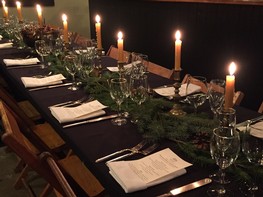
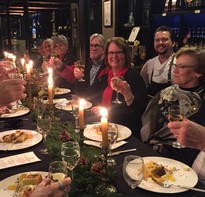
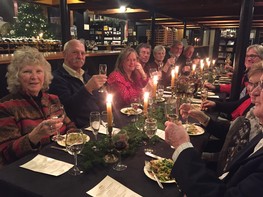
A December Dinner in the Tasting Room
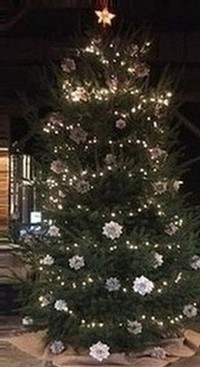
Every year, the Patterson Library hosts an August auction - and this year loyal supporters of the Library purchased a dinner hosted by Johnson Estate Winery
(actually, there were two dinners, but that is another story).
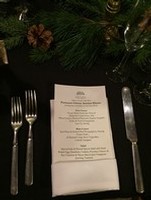
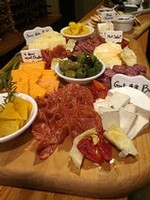
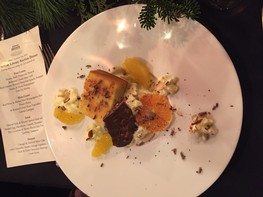
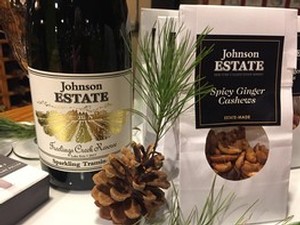
We are sharing photographs and Chef Edward Work's menu for the dinner held on December 13th in the tasting room when it was all decorated for Christmas. Chef Ed is the head chef at the Athenaeum Hotel, but off-season, is able to share his talents with us and others. The meal was delicious and perhaps offers readers some food and wine pairing ideas!
* * *
Appetizers
Artisan Cheese and Charcuterie Board with Assorted Pickles, Olives & Jams
Bacon-Wrapped Dates Stuffed with Blue Cheese
First Course
House-Made Fettucinne with Butternut Squash Cream Sauce &
Wilted Greens, Roasted Butternut Squash & Pumpkin Seeds
Semi-Dry Riesling
Main Course
Red Wine & Herbed Beef Bourguignon, Parsnip Potato Purée,
garnished with Crispy Root Vegetables
Cabernet Sauvignon
Salad
Shaved Kale & Brussel Sprouts with Hard Boiled Egg, Hazelnuts, Craisins, Pecorino Cheese,
Rye Croutons & Sherry-Bacon Jam Vinaigrette
Sparkling Traminette
Dessert
Orange & Almond Cake with Chantelle Cream,
Orange Supreme, Almond Bark & Dark Chocolate Shavings
Cream Sherry
Dec 15, 2019 at 10:36 AM
Permalink
Lake Erie Wine Country - Harvest Wine Weekend - Gourmet's Guide & Recipes
Oct 28, 2019 at 5:04 PM
Permalink
Edible Western New York - Nature versus Nuture - In Jennifer's Kitchen
Stephanie Burdo, editor and publisher of Edible Western New York, shares an afternoon in Jennifer Johnson's fall kitchen.....here's her article, complete with photographs by Jill Bornand.
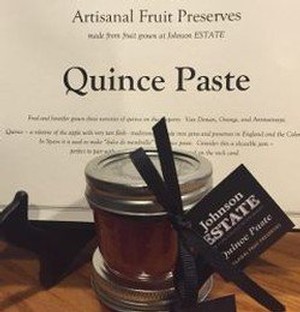
This article includes recipes for quince - the "prehistoric" apple which has been grown in North American since the Colonial days - but alas is not always so easy to find today. A number of our customers are interested in purchasing quince fruit - and as our quince trees were decimated by fire blight, we have little fruit and not of the quantity or quality which I would feel comfortable selling. I've contacted three orchards which I thought were likely to have quince - but have struck out so far.
We'll keep looking for some resources on quince fruit to share.
As Edible Western New York's focus is good, local foods, I would be remiss not to remind readers to visit its website, where one can search articles and events and sign up for the Edible WNY Newsletters. In addition, three other resources for those who are interested in locally produced
fruit and vegetables as well as meats.
www.postapples.com (North East, PA) - vegetables and apples
www.facebook.com/chautauquaregionfarmtotable
Cornell Cooperative Extension Website - Chautauqua-grown
Oct 15, 2019 at 6:30 PM
Permalink
Lake Erie Wine Country Wineries Strike Gold!
April 21, 2019 For Immediate Release Contact Monica Mazur, 877-326-6561
Lake Erie Wine Country Wineries Strike Gold at the 2019 Finger Lakes International Wine Competition
Westfield (NY) – Eight local wineries went up against over 650 competing wineries from all over the world and came away with a disproportionate share of the top honors. There were over 2800 wines entered in the 19th Finger Lakes International Wine Competition held on April 13th and 14th in Rochester NY. This event has become the largest charitable wine competition in North America, as each of the over 2800 entries contributes over $50 to Camp Good Days and Special Times, a camp dedicated to bringing smiles and memories to children with cancer.
Of the 64 top honors awarded (Best of Class or Double Golds), twelve were won by the over one-hundred New York and Pennsylvania wineries entering the competition. Of those twelve Best of Class or Double Gold awards presented, four of them – or one third - were earned by Lake Erie Wine Country wineries! In addition, the eight LEWC wineries who submitted wines to this competition also earned seven gold medals and multiple silver and bronze recognitions as follows. Complete results available at https://fliwc-cgd.com/winners-2019.asp.
Summary of Awards Earned by Lake Erie Wine Country Wineries:
21 Brix (Portland, NY) - Best of Class, Sparkling - 2017 Bruttella
Gold - Ella’s White Niagara
7 silver and bronze medals
Johnson Estate Winery (Westfield, NY) - Double Gold – 2017 Freelings Creek Semi-Dry Riesling
Gold - 2017 Freelings Creek Sweet Riesling
Gold - 2017 Maple Liqueur
Gold - 2017 Solstice Sangria
7 silver and bronze medals
Presque Isle Winery (North East, PA) - Double Gold – Eskimo Kisses (dessert wine)
5 silver and bronze medals
Yori Cellars Winery (North East, PA) - Double Gold – Famiglia (red wine)
12 silver and bronze medals
Arrowhead Wine Cellars (North East PA)
Gold - “Midnight Proposal”
3 silver and bronze medals
Lakeview Wine Cellars (North East PA)
Gold – 2017 Traminette
4 silver and bronze medals
Liberty Vineyards & Winery (Sheridan NY)
Gold – “Lucy in the Sky Sweet Rosé”
5 silver and bronze medals
Heritage Wine Cellars (North East PA)
10 silver and bronze medals
Lake Erie Wine Country (LEWC) is a marketing association of 23 wineries located along the shores of Lake Erie in western New York and Pennsylvania amidst 30,000 scenic acres of juice and wine grape vineyards. Additional information found on the LEWC website, www.LakeErieWineCountry.org.
Apr 29, 2019 at 11:40 AM
Permalink
Photos of Tastes of Germany
TASTES OF GERMANY, April 12-14, 2019 at Johnson ESTATE Winery
Last night's hail storm would not make one believe that we are on the cusp of spring - but here are some other signs!
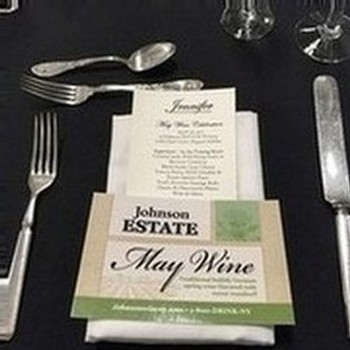

April 12-14, Wine & Cheese Weekend, Lake Erie Wine Country
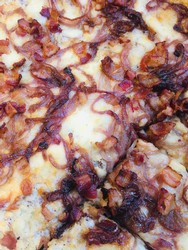
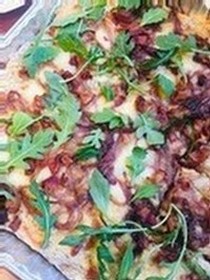
Johnson Estate Winery featured Flammkuchen, or Flame Cake, paired with Sweet Riesling.
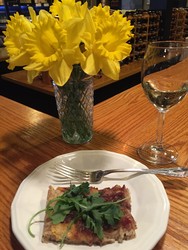
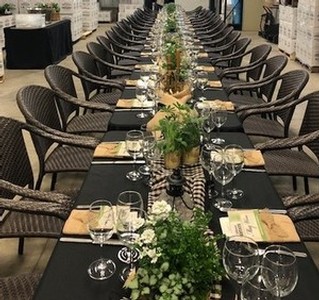
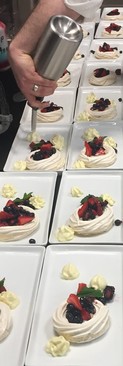
April 13, ESTATE Dinner: A Taste of Germany - May Wine Release
Featuring Exec. Chef Edward Work, Heirloom Restaurant, Athenaeum Hotel
Tablescape by Mary Marzec
Chocolates from Le Rouge by Aarti, Westport, CT
Apr 15, 2019 at 4:21 PM
Permalink